What actually happened
The short version, still true in August 2026: Shopify no longer allows vape products. Anywhere. At all. That includes the UK.
The longer version matters, because the dates tell you how much warning the next category will get.
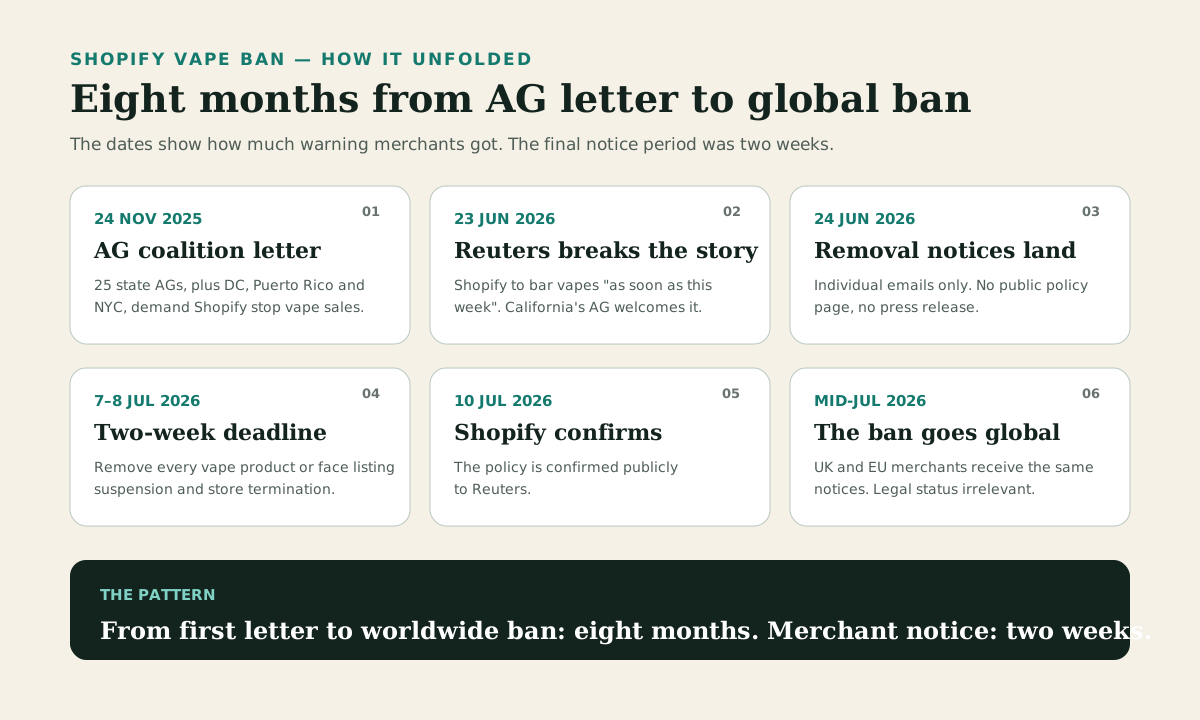
- 24 November 2025. A bipartisan coalition of 25 state attorneys general, plus DC, Puerto Rico and New York City, sent Shopify a letter demanding it stop supporting vape sales. The letter named 29 Shopify-hosted sites. It's public on the California AG's website.
- 23 June 2026. Reuters reported Shopify would bar vapes "as soon as this week". California AG Rob Bonta welcomed the ban the same day.
- 24 June 2026. Merchants started receiving individual notices: Shopify "no longer supports the sale" of electronic nicotine delivery systems. No public policy page, no press release. Just emails.
- 7–8 July 2026 (UTC). Deadline. Remove every vape product or face listing suspension and store termination. Two weeks, for stores that had traded on the platform for a decade.
- 10 July 2026. Shopify confirmed the policy to Reuters.
- Mid-July 2026. The other shoe dropped. The ban applies globally, not just in the US. Bonta's office told Reuters as much, and Vaping360 reported UK and EU merchants receiving the same eviction notices.
The scope is categorical. Hardware, e-liquids, pods, disposables, coils, accessories. It includes the 45 products the FDA has actually authorised. Legal status is irrelevant.
Yes, it applies to you
If you read early coverage saying UK merchants weren't affected, that advice is out of date. Some of it is still ranking on Google, which is genuinely unhelpful for anyone searching now.
A UK shop selling MHRA-notified, fully compliant reusable vapes to adults is doing something legal. Doesn't matter. Shopify's ban overrides local law, because it isn't law, it's a landlord's house rule. To be clear, this is separate from the UK's own single-use disposables ban from June 2025. That one came from Parliament. This one came from an email.
We'd add one honest caveat: Shopify is within its rights here. Every hosted platform reserves the right to decide what it will and won't support. That's exactly the problem.
Can you still sell vapes on Shopify?
No. Not in any market, not in any quantity, and not even if the FDA has authorised the exact product you're selling.
That is worth stating plainly because a lot of the advice still circulating draws distinctions that no longer exist. There was a period where the ban looked US-only, and a period where people assumed compliant reusable devices would be carved out. Neither turned out to be true.
What the ban covers, based on the notices merchants actually received:
- Devices and hardware. Pod kits, mods, disposables, batteries.
- E-liquids and nicotine salts, at every strength including zero-nicotine lines sold alongside them.
- Coils, pods, and the accessories that only make sense next to a vape.
- Products the FDA has formally authorised. All 45 of them.
What is not covered: your other products. The ban is written against a category, not against you as a merchant. If vape is 20% of your catalogue, you can strip it out and carry on trading the rest on Shopify. Several stores have done exactly that, and for some of them it was the right call.
The question worth asking is not whether you can technically stay. It's whether the category you have left is a business you want to run, and whether the next policy email lands on something else you sell. If you also stock nicotine pouches or CBD, you are not in a different position to the vape merchants were in May. You are in the position they were in before the email arrived.
This was never just about vapes
Here's the part that should worry you even if you've never sold a vape in your life.
The pressure campaign worked, and everyone involved knows it worked. The attorneys general have signalled other platforms and payment processors are on their list. Stripe, PayPal and Square already exclude vape in their acceptable use policies. If your products sit anywhere near a regulator's radar, CBD, nicotine pouches, peptides, supplements, knives, adult products, you are one policy email away from the same two-week deadline.
In our experience running restricted-category stores, the pattern is always the same. You build on a platform, you follow the rules, the rules change, and the notice period is measured in days. Paid ads were never available to you in the first place. Now the platform itself is conditional.
So the question isn't "which Shopify alternative?". It's "how do I stop renting?".
Your four real options
Most of the migration guides published since July recommend the same three platforms and move on. The honest version has four options, and the right one depends on your size.
1. Stay on Shopify, exit the category. If vape is a side line, removing it and keeping the store may be rational. Do the maths before sentiment does it for you.
2. Move to another hosted platform. BigCommerce and similar will take your store today. Before you migrate, get their policy on your category in writing, not a sales call, an email from someone whose title includes "compliance". Then accept what you're doing: moving from one landlord to another, hoping the next AG letter goes to someone else's platform. For some stores that's a reasonable bet. Call it what it is.
3. Self-host WooCommerce or Magento. Nobody can deplatform a WordPress install. This is a legitimate answer, especially under about £500k turnover, and plenty of the stores displaced in July went this way. The trade is that you now own hosting, security, updates and performance, and WooCommerce at serious catalogue size needs real engineering attention anyway.
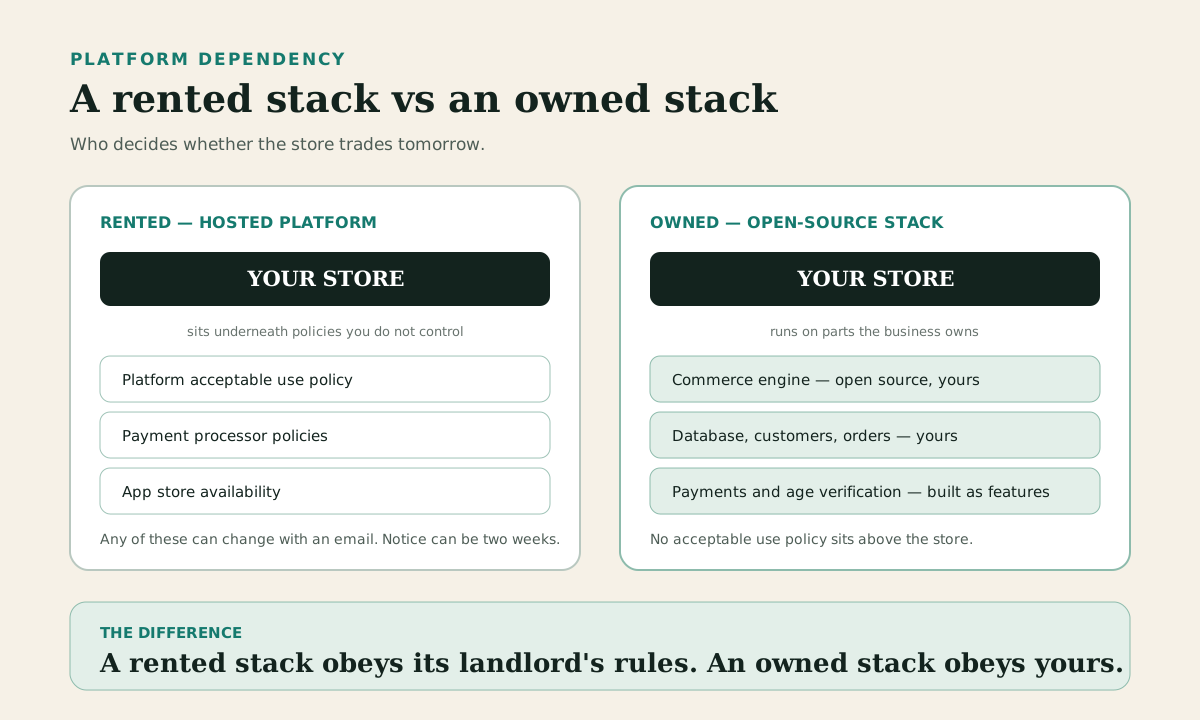
4. Own the stack properly: headless, open source. Build on an open-source commerce engine (MedusaJS is the one we use) with your own frontend, your own database, your own payment integrations. No acceptable use policy exists. Age verification and compliance become features you design rather than apps you hope stay compatible. Critically, you can keep the processor and warehouse you already run. This is the most work and the most freedom, and until recently it was an enterprise-only conversation. It isn't anymore.
Not one of the ban guides we reviewed mentions option 4. Every one of them was written by an agency that resells options 2 or 3.
You can keep CyberSource and Linnworks
Most merchants hear "leave Shopify" as "rip out payments, rip out the warehouse, start again." That is what a hosted-platform migration actually is, because those systems were apps. On an owned stack they are yours.
CyberSource, or whichever acquirer already underwrites you, can stay the processor. Linnworks can stay the warehouse. Age-verification records can come across. The storefront and the commerce engine change. The operating systems you already run do not have to.
That is the practical difference between option 2 and option 4. Another hosted platform means a new landlord, a new app stack, and another acceptable-use policy. An owned MedusaJS build means the engine talks to the processor and the warehouse you already have. The £4.5M rebuild was designed that way because replacing CyberSource and Linnworks in the same window as a platform move would have been a second project nobody had time for. Production cutover on that store has not been verified.
Two caveats, because this is the part agencies oversell. Payment risk still follows the merchant, not the platform: keeping CyberSource does not skip underwriting if the current MID cannot travel. And Linnworks only stays if someone builds the channel properly — Medusa as the endpoint it already polls, with inventory apply behind a switch, not a CSV dump. If you want the decision surface for that work, it is the MedusaJS agency page, not another Shopify alternative list.
How to actually choose a vape ecommerce platform
Most platform comparisons for this category rank features nobody gets deplatformed over. When we chose a destination for the £4.5M store, we ignored those matrices. Here is what we actually checked, roughly in the order we have seen things go wrong.
Get the category approved in writing
Not a sales call. Not a line on a marketing page. An email from someone whose job title contains the word compliance, naming your product category, that you can produce in twelve months when a different person tells you something different. If a platform won't put it in writing, you have your answer.
Solve payments before you solve platform
This is the one that catches people. Your platform choice is nearly irrelevant if no acquirer will underwrite you, and high-risk underwriting runs to weeks. Talk to gateways first, find out what they'll take, and let that shape the build. We have seen this sequenced the wrong way round more than once, and it is an expensive mistake to unwind.
Check that age verification survives the move
Every serious vape store has an AV flow, and most have a large stock of customers who have already passed it. If your new platform can't import those completed verifications, every returning customer gets asked again at exactly the moment they are already unsettled by a new website. That is a conversion problem disguised as a compliance problem.
Ask what the exit looks like
You are reading this because a platform changed its mind. Before you commit to the next one, find out how you would leave: whether you can export orders and customers in full, whether your URL structure is yours, whether redirects are something you control. The answer tells you how much bargaining power you are handing over.
UK stores: check it can handle duty
From 1 October 2026 you need duty stamps and HMRC registration. Any platform you pick has to cope with that in pricing, stock and compliance reporting. Building it in now is cheaper than retrofitting it in September.
The questions none of the guides answer
Five things we know from doing this that we couldn't find written down anywhere.
Export everything before termination, not after
A suspended store can still lose you your data access. Products, customers, orders, redirects, blog content, theme files. Do it this week even if you haven't picked a destination.
Your redirects die with your store
This is the nasty one, and it is the single most common question we see asked with no useful answer attached.
Every URL your store has earned over the years is served by Shopify. Not by your domain, by Shopify. When the store goes, the server that was answering those requests stops answering them, and your ability to 301 anything to its new home goes with it. Your domain still points somewhere, but there is nothing behind it that knows what /collections/nic-salts used to be.
The practical consequence: if you wait for termination, you do not get to do a clean migration afterwards. You get to rebuild your rankings from scratch, and a decade of accumulated URL equity is simply gone. There is no retrospective fix, because the mapping information you needed lived in the store you no longer have.
Done in the right order it is a solved problem. Export the URL list while you still have admin access. Map every old URL to its new equivalent one-to-one. Import the redirects into the new store, verify them, and only then point the domain. We mapped 2,938 live URLs and imported 9,418 redirects, then checked every one for chains and loops before switching anything off. That work has to happen while you still control the Shopify store, which is why "wait and see" is the most expensive option on the table.
Start payments before you start building
High-risk merchant accounts take weeks of underwriting. A finished store that can't take money is a very expensive brochure. Applications first, build second.
Worth knowing: payments risk follows the merchant, not the platform. Moving to WooCommerce does not make an acquirer more comfortable with your category, because the acquirer is underwriting what you sell, not what you sell it with. That is the piece most migration advice misses entirely.
Age verification is a build item, not a checkbox
Whatever platform you land on, your AV flow has to survive the move, and your existing verified customers ideally shouldn't have to verify again. We carried 52,559 completed age verifications across so returning customers never noticed.
What it costs, honestly
Nobody publishes real numbers for this, and the ones you do see tend to come from whoever is selling the cheapest option. We are not going to quote you a figure for your store from a blog post, but we can tell you what actually drives the cost, because the spread between stores is enormous.
The cheap end is a small catalogue, no historical order import, no loyalty or subscription logic, and a willingness to accept a fresh start on rankings. That can genuinely be a few thousand pounds on self-hosted WooCommerce, and for a store under a few hundred thousand a year it is often the right answer.
The cost climbs with four things specifically: how many historical orders and customers have to come across intact, how much of your merchandising logic lives in apps that have no equivalent on the new platform, whether age verification and compliance need rebuilding as real features, and how much URL equity you cannot afford to lose. A store with half a million historical orders and a decade of SEO is a different project to a store with two thousand orders and a Google Business Profile.
The honest framing is not "what does a migration cost". It is "what does a fortnight of not trading cost", because that is the number that decides whether the engineering is expensive or cheap. Multiply your monthly revenue by the fraction of a month a forced migration would take. For most stores reading this, that calculation answers the question on its own.
If Shopify has already suspended your store
We have had this conversation with merchants who only found us after Shopify had already locked the admin. Everything above assumes you still have access. If you don't, the advice changes, and most of what is written about this ban is no use to you at all.
Work in this order.
Check your domain first, today. If you registered your domain with an independent registrar, it is yours and nothing that happens to your store touches it. If you bought it through Shopify, Shopify is your registrar, and that is a very different conversation to have while your account is in a bad state rather than after. Log in and find out which one you are. This is the single most time-sensitive thing on the list, because your domain is the only asset in this situation that can genuinely become unrecoverable.
Get whatever data you can still reach. Suspension and termination are not the same thing, and there is often a window between them where exports still work. Take products, customers, orders and any redirect list you can, in that order. If admin is gone entirely, your payment processor, your email platform and your accountant between them hold more of your customer and order history than you would expect.
Put something on your domain. A single page explaining what happened and collecting email addresses is worth building the same day. Customers who search for you and hit nothing assume you have gone under. Customers who hit a holding page mostly wait.
Then payments, then platform. The sequencing in the section above does not change just because you are in a hurry. Underwriting takes as long as it takes, and starting it late is what turns a three-week outage into a three-month one.
The hard truth about rankings: if the store is already off, the redirect window has closed and some of your search equity is not coming back. It is recoverable over months rather than days, and it is recovered by rebuilding on URLs that make sense rather than by trying to reconstruct the old ones. We would rather tell you that now than sell you a plan that quietly assumes otherwise.
What moving a £4.5M vape store actually took
We're not writing about this from news reports. Hollow Point rebuilt a £4.5M UK vape retailer on Medusa Cloud, off Shopify. The migration was already under way when the ban landed and turned a strategic decision into a mandatory one.
The scale, since honest numbers are hard to find in this conversation: 2,933 products across 207 collections. 260,880 customer accounts with 206,750 addresses. 511,740 historical orders with 1.6 million line items, imported with zero errors in the run logs. 280 blog articles kept at their original URLs. Age verification, loyalty points, promotions logic and transactional email rebuilt as first-class features rather than a stack of apps.
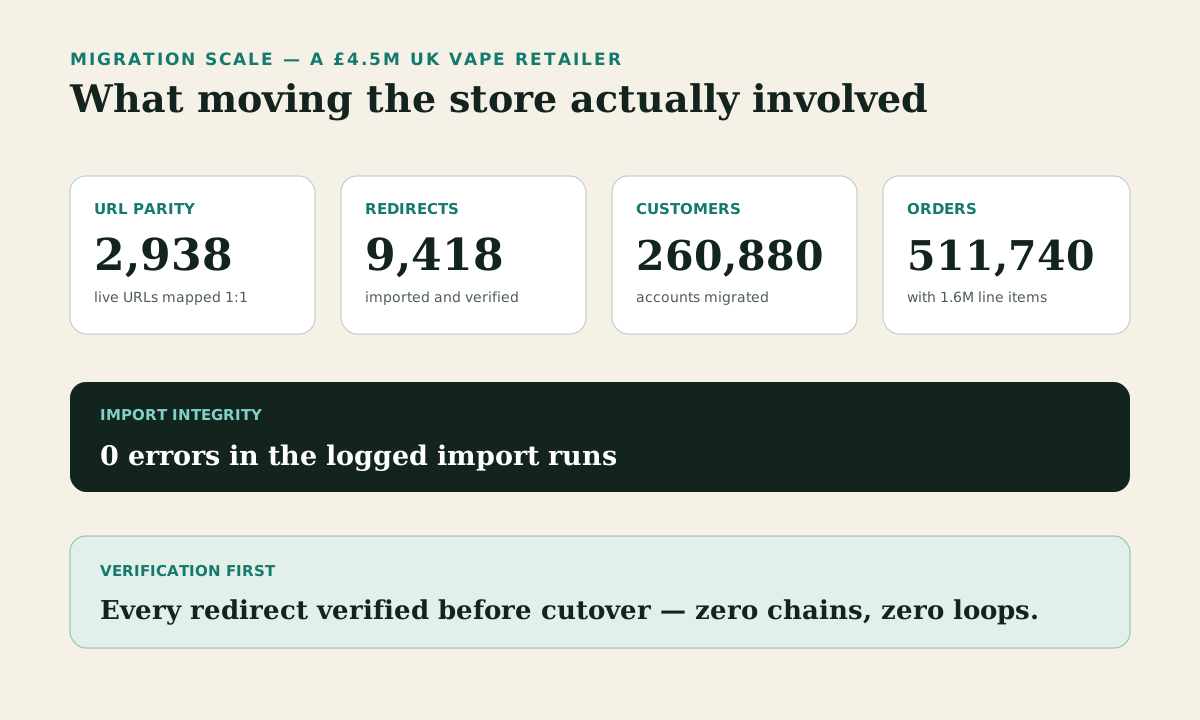
And the SEO groundwork: every live URL mapped, every redirect imported and verified, zero redirect chains or loops. The method is written up in our URL parity case study if you want the detail.
None of that took ten minutes, whatever the migration marketing says. It took months of proper engineering. That's the price of never getting the email again, and for a store doing millions in a category platforms keep evicting, we think it's obviously worth paying. For a store doing £200k, it probably isn't, and we'll say so if you ask.
Which option fits which store
- Under ~£500k, simple catalogue: self-hosted WooCommerce. Take the ops burden, keep the freedom.
- £500k–£1M, standard products, low regulatory heat: a hosted alternative with your category approved in writing can work. Keep exports current. Know where the exit is.
- £1M+, restricted category, or your store IS the business: own the stack. The engineering cost stops looking expensive the day you multiply your revenue by the number of days a forced two-week migration would take.
- Any size: if the platform can evict you and you'd struggle to trade within a month, you have a continuity problem worth solving before someone else schedules it.
UK merchants: your clock is running twice
If you're a UK vape retailer, the Shopify ban is only half your year. The new vaping products duty arrives on 1 October 2026, with duty-paid stamps and HMRC registration. You're re-engineering pricing, compliance and stock anyway. Doing your platform move in the same window is one disruption instead of two, and it means your new store launches already built for the duty regime rather than patched for it. That's the sequencing we'd run. It's the sequencing we did run.
Common questions
Is the Shopify vape ban global?
Yes. It began as a US enforcement response but applies worldwide, including to UK and EU merchants selling legal, MHRA-notified products. Merchants outside the US received the same removal notices.
Does the Shopify vape ban apply in the UK?
Yes. UK merchants received the same removal notices as US stores. MHRA-notified, fully legal products are not exempt. The ban is a Shopify house rule, not a change in UK law, and it is still in force in August 2026.
Does the ban affect CBD or other restricted products?
Not directly, this ban covers nicotine vaping products (ENDS). But the mechanism that produced it, regulator pressure leading to a platform policy change with a two-week deadline, applies to any restricted category. CBD merchants should treat it as a warning shot.
Can I appeal a Shopify vape ban decision?
Realistically, no. The ban is categorical, so appeals only help false positives, a store wrongly flagged that doesn't actually sell ENDS products. If you sell vapes, the policy is the policy.
Will I lose my Google rankings if I migrate off Shopify?
Not if the migration preserves your URLs or redirects every old URL to its new equivalent before the old store is switched off. That work has to happen while you still control the Shopify store. We mapped 2,938 URLs and verified 9,418 redirects for exactly this reason.
Can I keep selling non-vape products on Shopify?
Yes. The ban covers ENDS products, not merchants. Some stores are splitting: general catalogue stays on Shopify, regulated catalogue moves to an owned platform.
What happens to my myshopify.com domain and store data if I'm terminated?
Your custom domain is yours; the myshopify.com address and everything served by Shopify is not. Export products, customers, orders, redirects and content while you have normal access. After termination you may not get another chance.
Can you still sell vapes on Shopify?
No. The ban covers every market and every vape product, including devices, e-liquids, coils, accessories and the 45 products the FDA has authorised. It applies whether or not your products are legal where you trade. You can keep selling your non-vape catalogue on Shopify, because the ban is written against the category rather than the merchant.
Shopify banned my store. What should I do first?
Check who registered your domain before anything else. If you bought it through Shopify then Shopify is your registrar, and that is far easier to resolve while your account still exists. Then export whatever data you can still reach, put a holding page on your domain so customers know you have not gone under, and start payment underwriting before you start choosing a platform.
What is the best ecommerce platform for a vape shop?
There is no single answer, and any agency giving you one is describing what they sell. Under roughly £500k with a simple catalogue, self-hosted WooCommerce is usually right. Above £1M, or in a category regulators are actively watching, an open-source stack you own outright removes the policy risk entirely. What matters more than the platform is getting your category approved in writing, confirming payment underwriting first, and checking that your age verification records can come across.
Can I keep CyberSource and Linnworks if I leave Shopify?
Yes, if you move to a stack you own rather than another hosted platform. CyberSource can stay the processor and Linnworks can stay the warehouse; they stop being Shopify apps and become integrations the new engine talks to. Underwriting still follows the merchant, and the warehouse channel has to be built rather than assumed.
What has changed since we published
This piece is kept current because the situation keeps moving. Substantive changes are logged here.
- 22 August 2026. Added the keep-your-processor-and-warehouse section (CyberSource + Linnworks) so the owned-stack option is explicit rather than implied. The ban is still in force in the UK.
- 17 August 2026. Confirmed the ban is still in force in the UK. Added a direct UK FAQ, because several guides still ranking for this query treat the UK as unresolved. Tightened the opening so the first sentence answers whether you can still sell vapes on Shopify.
- 10 August 2026. Added guidance for merchants whose stores are already suspended, a section on choosing a platform, honest cost drivers, and a direct answer on whether vapes can still be sold on Shopify. Expanded the redirect section, which remains the most-asked and least-answered question in this whole story.
- 31 July 2026. First published, after Shopify's ban was confirmed as global in mid-July.
Still to come: the UK vaping products duty on 1 October 2026, and whether the attorneys general move on the payment processors next. We will update this page when either happens.
Where we fit
Hollow Point is a MedusaJS development agency and official Medusa Expert. We migrate stores off Shopify onto stacks their owners actually own, keeping the processor and warehouse where they already work, with high-risk payments and age verification treated as engineering rather than plugins. If the ban email landed in your inbox, or you'd rather move before your category's version of it does, the honest first step is a conversation about whether you should move at all. Sometimes the answer is no. We'll tell you either way.
Also read: the Shopify to MedusaJS migration guide if you have already made the decision and want the order of operations, and 10 Shopify features we rebuilt in MedusaJS for the feature-level detail.
FREE / NO OBLIGATION
Get a Deplatforming Assessment
Tell us about your store and we will write back within 2 working days with a straight answer on where you stand. No call required, no pitch deck.
- Your realistic options, including the ones that mean not moving at all
- What each option costs and how long it actually takes
- What happens to your Google rankings, and what has to be done before the old store goes dark
- Whether your payments survive the move, and what to start now rather than later
We have done this at scale: a £4.5M UK vape retailer rebuilt off Shopify, 511,740 historical orders imported with zero errors in the run logs, and 2,938 live URLs mapped one-to-one so the rankings came across intact.
What happens next: Billy reads it, checks your store, and writes back. If the honest answer is that you should stay where you are, that is what the reply will say.
NEXT STEP / HOLLOW POINT
Would rather read than ask?
The detail behind the assessment: how we migrate restricted-category stores, and how payments, age verification and SEO get handled as engineering rather than apps.